How Much Will the 2026 Ohio Property Tax Credit Save Berea Homeowners?
For homeowners in Berea, the 2026 property tax changes are finally starting to show up in real numbers, not just policy headlines. After several years of rising home values and increasing tax pressure across Northeast Ohio, the state’s updated tax credit system is designed to slow that growth and provide more predictable relief.
The question most homeowners are asking is straightforward: how much will this actually save me?
The answer depends on your home’s value, whether you live in the property full-time, and how the new credits interact with Berea’s local tax structure. Once you break those elements down, the savings become much easier to understand.
Step 1: Understand What Changed in 2026
Ohio’s 2026 property tax reforms introduced two key changes that directly affect homeowners. The first is the expanded Owner-Occupancy Credit, which increases the tax benefit for people who live in their homes. The second is the Inflation Cap tied to school funding, which limits how much property taxes can increase when home values rise.
At the same time, the previous non-business credit is being phased out. This shifts the benefit away from investment properties and places more emphasis on owner-occupied homes.
For Berea homeowners, this means the system is now more focused on providing relief to primary residents rather than spreading it evenly across all property types.
Step 2: How the Owner-Occupancy Credit Works
The Owner-Occupancy Credit is the most direct way homeowners in Berea will see savings. This credit reduces the taxable portion of your property taxes, effectively lowering your annual bill.
Unlike a flat rebate, this credit is tied to your tax amount. That means the higher your property taxes, the larger your potential savings in dollar terms. However, even modestly priced homes still benefit from the reduction.
The most important requirement is that the home must be your primary residence. Without that classification, the credit does not apply.
Step 3: What the Inflation Cap Actually Does
The Inflation Cap is less visible, but just as important. It applies to school districts operating at the 20-mill floor, which is common across Northeast Ohio.
Under this rule, even if property values increase significantly, school districts cannot collect more revenue than the rate of inflation. This prevents the sharp tax increases that often followed reappraisal cycles in the past.
For Berea homeowners, this means your tax bill becomes more stable over time. Instead of reacting to large jumps, you can expect more gradual and predictable changes.
Step 4: What This Looks Like in Real Savings
To understand how this affects you directly, it helps to look at a typical Berea home.
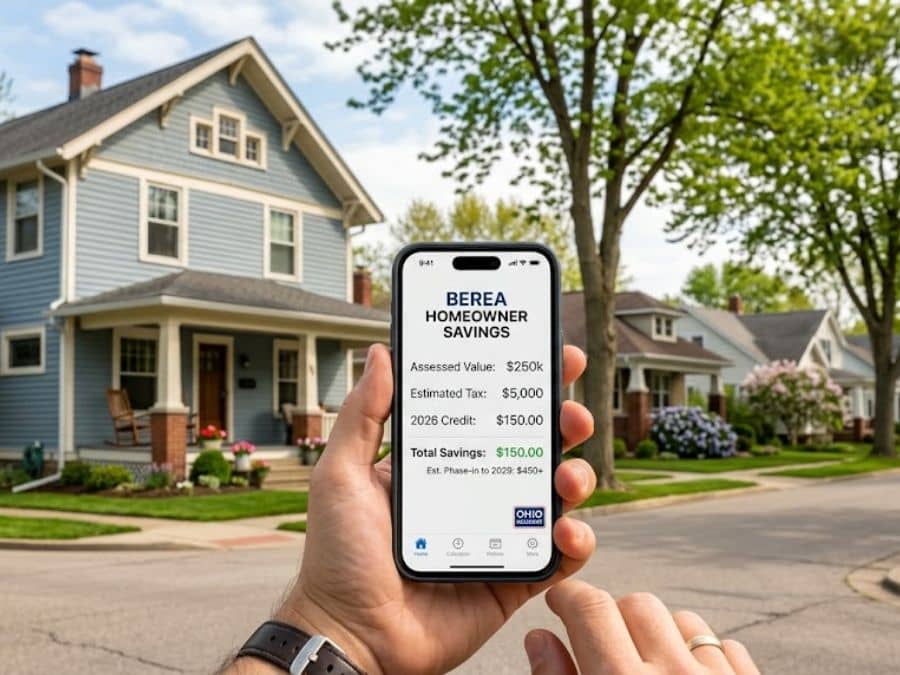
Using a $250,000 home as an example:
- Assessed value (35 percent): $87,500
- Estimated annual property taxes: around $5,000
With the expanded Owner-Occupancy Credit in 2026, many homeowners are seeing savings in the range of:
- Approximately $100 to $200 per year initially
While that number may seem modest, it represents the beginning of a phased increase in relief that will continue over the next several years.
Step 5: Why Berea Falls in the “Moderate Savings” Range
Berea sits in Cuyahoga County, where property taxes tend to be higher than in many parts of the state due to strong school funding and multiple local levies. Because of this, the tax credit does not dramatically reduce total costs, but it does soften their growth.
In practical terms, homeowners will likely notice:
- Smaller annual increases
- A reduction in overall tax pressure
- More consistency from year to year
The real benefit is not just immediate savings, but the prevention of larger increases in the future.
How Berea Compares to Nearby Suburbs
While the 2026 property tax credit applies across Ohio, the actual savings vary depending on local property values and tax structures. Comparing Berea to nearby suburbs helps illustrate how those differences play out.
| City | Typical Home Value | Estimated Annual Taxes | 2026 Credit Savings | Key Difference |
| Berea | $250,000 | ~$5,000 | ~$100–$200 | Balanced suburban tax base |
| Parma | $220,000 | ~$4,800 | ~$90–$180 | Slightly lower home values |
| Middleburg Heights | $300,000 | ~$6,200 | ~$120–$240 | Higher property values |
| Strongsville | $350,000 | ~$7,500 | ~$150–$300 | Higher overall tax exposure |
What this shows is that the credit works consistently as a percentage, but the dollar savings increase with higher home values and larger tax bills.
For Berea homeowners, this places the city in a middle-ground position. It offers moderate but steady savings compared to both lower-cost and higher-cost suburbs.
Step 6: The Long-Term Impact Through 2029
The structure of the 2026 reforms is designed to increase benefits over time. The Owner-Occupancy Credit will continue to expand, meaning homeowners should see larger savings in future years.
At the same time, the Inflation Cap remains in place, limiting how quickly taxes can grow as property values increase. This combination creates a system that gradually shifts from short-term relief to long-term stability.
By the end of the rollout period, homeowners are expected to see:
- Greater percentage-based reductions
- More predictable tax behavior
- Stronger protection against market-driven spikes
Pro Tip: Make Sure You Are Getting the Credit
To receive the Owner-Occupancy Credit, your home must be properly classified as your primary residence. If you recently purchased a home in Berea, confirm that this designation was filed correctly during closing.
Without it, you may be taxed at a higher effective rate and miss out on the credit entirely. This is one of the simplest but most important steps in making sure you receive the full benefit of the 2026 changes.
What This Means for Berea Homeowners
The 2026 property tax credit does not dramatically reduce your bill overnight. Instead, it changes how your taxes behave moving forward.
For Berea homeowners, the impact comes down to three key benefits:
- Modest immediate savings
- Protection from sharp increases
- Increasing relief over time
In a region where rising property values have driven tax concerns, this shift toward predictability is just as important as the actual dollar savings.
The Bottom Line
If you own a home in Berea, the 2026 property tax credit will likely save you in the low hundreds of dollars during the first year, with greater savings as the program expands. More importantly, it reduces the risk of sudden tax spikes and creates a more stable system for long-term planning.
In 2026, the real advantage is not just what you save today—it is the confidence of knowing what your tax bill is likely to do next.