How Much Will the Issue 2 Road Levy Cost a Bainbridge Homeowner?
For homeowners in Bainbridge Township, ballot issues like the Issue 2 Road Levy are not just political decisions—they translate directly into real dollars on your annual property tax bill. When a levy appears on the ballot, one of the first questions most residents ask is simple: how much will this actually cost me?
The answer depends on your home’s value, how Ohio calculates property taxes, and the specific millage tied to the levy. Once you break those pieces down, the cost becomes much easier to understand.
What Is the Issue 2 Road Levy?
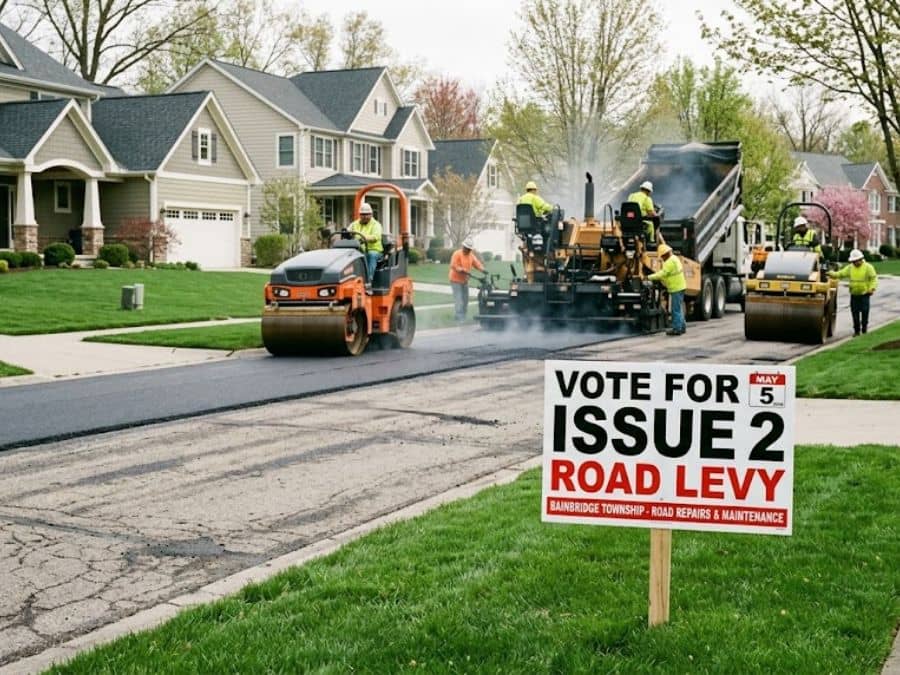
The Issue 2 Road Levy in Bainbridge Township is designed to fund road maintenance, repairs, and infrastructure improvements. Like most township road levies in Ohio, it is structured as a property tax based on millage, which determines how much each homeowner contributes.
These levies are typically used for:
- Road resurfacing and repairs
- Snow removal and seasonal maintenance
- Drainage and infrastructure upgrades
- Ongoing township road operations
For a growing township like Bainbridge, these levies help maintain the quality and safety of local roads over time.
Understanding Millage in Simple Terms
To understand what the levy will cost you, it is important to understand how millage works.
One mill equals $1 of tax for every $1,000 of a property’s assessed value. In Ohio, homes are taxed at 35% of their market value, not the full value.
That means:
- A $400,000 home is taxed on an assessed value of $140,000
- Each 1 mill would cost about $140 per year
This formula is the foundation for calculating what any levy will cost.
Estimated Cost for a Typical Bainbridge Homeowner
While the exact millage for Issue 2 may vary depending on the ballot language, most township road levies fall within a common range. Using a typical example helps illustrate what homeowners can expect.
If the levy is 1 mill, the estimated annual cost would look like this:
| Home Value | Assessed Value (35%) | Annual Cost (1 mill) |
| $300,000 | $105,000 | $105 |
| $400,000 | $140,000 | $140 |
| $500,000 | $175,000 | $175 |
| $600,000 | $210,000 | $210 |
If the levy is 2 mills, you would simply double those numbers.
This gives homeowners a practical way to estimate their personal impact based on their property value.
The 2026 Factor: Why the Cost Feels Different Now
In 2026, Ohio property tax changes have added another layer to how levies behave. Under the updated system, school districts at the 20-mill floor are now subject to an inflation cap, which limits how much revenue they can collect as property values rise.
However, it is important to understand that this cap does not apply to new or voter-approved levies like Issue 2. That means if the levy passes, it is added to your tax bill based on its full millage rate.
For Bainbridge homeowners, this creates a mixed effect:
- Existing taxes may feel more stable
- New levies still add directly to your total bill
This is why new ballot issues stand out more clearly in 2026—they are one of the few ways your tax bill can increase in a noticeable way.
What Makes Bainbridge Unique
Bainbridge Township sits within Geauga County, where property taxes already trend higher than the state average due to strong school funding and local services. Because of this, even smaller levies can feel more noticeable when layered onto an existing tax structure.
At the same time, Bainbridge residents often see direct benefits from these levies. Road quality, snow removal, and infrastructure maintenance tend to be well-supported compared to less-funded areas.
This creates a familiar trade-off: slightly higher taxes in exchange for maintained local services and property values.
A Quick Cost Snapshot
To simplify the decision, here is how to think about the levy in practical terms:
| Levy Size | Approximate Cost on $400K Home |
| 1 mill | ~$140 per year |
| 1.5 mills | ~$210 per year |
| 2 mills | ~$280 per year |
These estimates provide a clear baseline for evaluating what the levy would mean for your household budget.
What Homeowners Should Consider
When evaluating a road levy like Issue 2, the decision usually comes down to weighing cost against long-term value.
On the cost side, the increase is typically incremental when viewed annually. Spread across monthly budgeting, even a 2 mill levy often translates into a relatively modest increase.
On the value side, well-maintained roads can:
- Support property values
- Improve daily convenience and safety
- Reduce long-term repair costs for the township
For many homeowners, the question becomes less about whether the levy costs money and more about whether the benefit justifies that cost.
Finding the Real Impact
For a Bainbridge homeowner, the Issue 2 Road Levy is not a vague tax—it is a measurable addition to your annual bill. By understanding millage and applying it to your home’s assessed value, you can calculate your exact cost with confidence.
In most cases, the increase will fall within a predictable range, making it easier to plan and evaluate. In 2026, when much of the tax system has shifted toward stability, new levies like this stand out as one of the clearest variables you can actually control.